Five Things to Remember About FLP’s/LLC’s
In this blog post, which is more on the technical tax-side, I lay out five important things to remember about structuring family entities. Spoiler alert: My next blog will be entitled Five More Things to Remember About… FLP’s/LLC’s
Is the FLP/LLC the right fit in this situation? Many mistakes that are made in the FLP/LLC arena probably arise in the inappropriate evaluation of the suitability of this technique. Simply, many FLP’s/LLC’s fail due to improper “fit.”
FISCAL FITNESS
Make sure the FLP/LLC is the right fit in your situation! Most mistakes that are made in the FLP/LLC arena are due to the inappropriate evaluation of the suitability of that entity technique in a particular situation. Simply put, many FLP’s/LLC’s fail due to improper “fit.”
Is your client too old or unhealthy for the FLP/LLC? These are legitimate questions in light of the jurisprudence and rulings. See, e.g., TAM’s 9719006, 9723009, 9725002 and 9730004; and Thompson Est. v. Comr., T.C. Memo 2002-246; Schauerhamer v. Comr.. T.C. Memo 1997-242; Reichardt Est. v. Comr., 114 T.C. 144 (2000); Strangi Est. v. Comr., 115 T.C. 478 (2000), affd. in part and revd. in part, sub nom. Gulig v. Comr., 293 F.3d 279 (5th Cir. 2002); and Harper Est. v. Comr., T.C. Memo 2002-121.
Will your clients follow the rules for FLP’s/LLC’s? Do your clients understand the importance of following the rules? A perfectly formed and funded FLP/LLC that is imperfectly administered (e.g., non pro rata distributions, commingling, etc.) probably will not work for estate tax purposes. See, e.g., Schauerhamer Est. v. Comr., supra; Reichardt Est v. Comr., supra; Harper Est. v. Comr., supra.
Will your clients pay for follow-up advice? What have you done to educate your clients as to the rules and the risks, and what written proof do you have of your efforts in this regard?
Do your clients need or require this level of complex planning? Can they handle that complexity? Do they understand the tax risks inherent with FLP’s/LLC/s? Did you consider/offer alternate estate planning techniques to them?
THE SUBJECT MATTERS!
The type of assets placed into an FLP/LLC make a difference. The assets contributed to FLP’s/LLC’s can have both tax and non-tax implications. Many clients are drawn to the FLP/LLC for its asset protection qualities. However, people sometimes put liability-prone property into an FLP/LLC with other valuable property, and, by so doing, fail to achieve the asset protection that could have been available had the assets been placed into separate entities to minimize cross exposure.
On the tax side, the wrong mix of marketable securities could cause the entity to be treated as an “investment company” under IRC Sec. 721. The contribution of appreciated property to an FLP/LL could give rise to considerations of allocation of built-in gain under IRC Sec. 704(c). Property encumbered by debt inside of an FLP/LLC can give rise to a number of tax issues relating to IRC Secs. 704, 705 and 752.
Not only can the financial nature of FLP/LLC property matter, but the percentage of a client’s property that is put into an FLP/LLC seems to matter, as well as the nature of that property. In Harper Est. v. Comr., supra. and Thompson Est. v. Comr., supra, the Tax Court applied IRC Sec. 2036 where the decedent had placed virtually all of his or her property into the partnership.
Many practitioners believe that the IRS has a bias against FLP’s/LLC’s that are entirely or heavily capitalized with marketable securities.
AVOID GRAY HEIRS
Avoid the grey area of assignees. One of the biggest areas of uncertainty in the law of FLP’s/LLC’s pertains to the rights and obligations of assignees of interests in FLP’s/LLC’s. Accordingly, a well-drafted FLP/LLC agreement should provide for rules pertaining to the rights of assignees and persons who should be admitted as owners (as opposed to being mere assignees) immediately upon adoption of the entity governance documents.
Some clients insist on making assignee-only transfers of FLP/LLC interests to children or other loved ones. It seems fairly clear today that the valuation differential between non-managing interests and assignee interests is marginal. So this is not a very compelling reason for making assignee-only transfers.
Where clients insist on assignee-only transfers, it is imperative that the agreement be fashioned to give these assignees some rights, particularly, the ability to avail themselves of the fiduciary duty of the entity managers and be given access to entity financial information. Otherwise, IRC Sec. 2036 could apply to include the date-of-death value of the gifted interests in the donor’s gross estate. In drafting for the rights of assignees, one may wish to distinguish between “good” assignees (like loved ones) and “bad” assignees (like creditors).
As mentioned above, in FLP’s/LLC’s, it is critical that some classes of people be automatically admitted as owners upon adoption of the governance agreements. Unlike corporations, FLP’s/LLC’s separate financial rights from management rights. If this is not carefully provided for in the governance documents, there could be an unwanted result of some family being held hostage on the outside as mere assignees in an FLP/LLC.
FIDUCIARY – NOT A FOUR LETTER WORD!
The “F” (Fiduciary) word is your friend. The thin reed of respect for transfer tax purposes accorded to FLP’s/LLC’s lies resplendent in the state law fiduciary duty owed by owners. See the U.S. Supreme Court’s opinion in Byrum v. U.S., 408 U.S. 125, 33 L. Ed. 2d 238, 92 S. Ct. 2382 (1972).
Estate planners cannot over emphasize to clients the existence and importance of the general partner/manager’s fiduciary duty—both in your advice and in the entity governance documents. Yet, in Kimbell v. U.S., Civ. Action No. 7:01-CV-0218-R, 2003 U.S. Dist. LEXIS 523 (N.D. Tex. January 15, 2003), the estate attempted to assert a Byrum fiduciary duty argument even though the partnership agreement expressly provided that the general partner owed no fiduciary duty to the partnership or to the other partners.
Once an FLP/LLC is formed and funded, the assets no longer belong to the contributors, and their use of those assets is no longer subject to their whim and caprice! While this should be obvious to estate planners, it is not always either obvious to or desirable by those clients who may be looking at the FLP/LLC not as an estate management and transfer device, but solely as a shell game of sorts. However, the estate planner must strive to weed the latter folks out as poor candidates for the FLP/LLC, as was discussed in No. 1 above.
Estate planning advisors also need to pay close attention to the indemnification/hold harmless provisions in the entity governance documents— fiduciary duty is of little importance if the document then essentially forgives all transgressions through indemnification.
Too often, we see relaxed statements of fiduciary duty, or overly generous indemnification/hold harmless provisions—some of these clauses are eerily similar to those seen in the go-go tax shelter limited partnerships of the 1980’s—where the limited partners indemnified the general partners against their own negligence and other transgressions, including, without limitation, criminal fraud! Avoid these types of clauses. Inclusion of such provisions invites the IRS to apply Code Section 2036.
Consistent with fiduciary duty is access to financial information of the FLP/LLC. It is impossible for an owner to realistically evaluate whether those in charge are fulfilling their fiduciary duties without meaningful access to financial information. This clause is important as well
LEARN TO LISTEN
Input and other rights of non-manager owners are necessary. It is imperative that careful attention be paid to fashioning rights of non-managing members, including, without limitation, accounting/information rights, distributions and voting input on significant or other extraordinary events. This is important for tax and non-tax reasons.
First, these rights protect the non-managing owners, and they act as reminders to those in charge that their control is not without limitations. Admittedly, some clients’ penchant for control may be so great as to rule them out as candidates for FLP’s/LLC’s.
Second, the existence of real rights on the part of the non-managing owners will support the bona fides of their interests, and of transfers of interests to them.
Non-managing FLP/LLC owners should be permitted to assign interests in the entity (subject to rights of first refusal and appropriate assignee rights). The managing owners should be required to make distributions of available cash, and the governance documents should provide some requirement that all determinations of whether there is any available cash should be made at least annually, with consequences to the managing owners if that doesn’t happen.
If a non-managing owner is not free to assign the economic interests in the FLP/LLC and if the managing owners are not required to make distributions of available cash, then the gift of any such interests may not qualify for the gift-tax annual-exclusion. See Hackl v. Comr., 118 T.C. No. 14 (2002); aff’d, 335 F.3d 664 (7th Cir. 2003). However, it also is conceivable that a transfer of such an interest may not be a gift at all (because of the extent of the tie up of the donee’s interests), with the result that the donor retained everything to be included in his estate under IRC Sec. 2036.
Granting the non-managing owners input on extraordinary events adds more validity and protection as it serves as a check on the authority of the managing owners and serves to backstop fiduciary duty.

Latest Episodes:
We released two episodes of The Cajun Counselor podcast in February – click below to tune in!
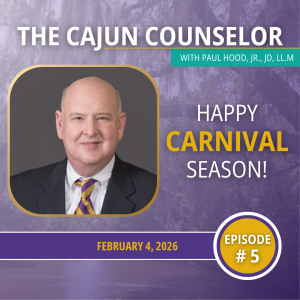
Episode 5: Happy Carnival Season aired on February 4, 2026 and in it, I celebrated the spirit of Carnival season and shared a few of my favorite king cake memories. Beyond the festivities, I dove into the core philosophies that drive my practice, including client empowerment in estate planning, and some stoic wisdom from the works of Marcus Aurelius.
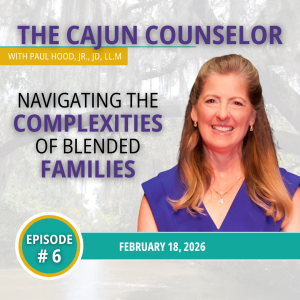
In Episode 6: Navigating the Complexities of Blended Families, which aired on February 18, 2026, I reached a exciting milestone: my very first interview with a guest! The brilliant Emily Bouchard joined me for this episode and together, we explored the intricate world of blended families, a subject we feel so strongly about that we even co-authored a book on it. We dove deep into the unique dynamics of “family by choice,” and discussed how modern structures – from wealth disparities to online relationships – require a more thoughtful approach than traditional estate planning offers.